As an educator in the classroom and a former principal on the South Side of Chicago, I've seen firsthand the challenges that students and staff alike face. American Education Week provides a crucial opportunity to shed light on an issue that continues to be ignored: the need to support the mental health of both students and educators.  In schools, the traditional focus on academic achievement must evolve to include the holistic well-being of everyone who walks through those doors. The American education system needs to be full of mental health champions. And it can be. Below are a few simple ways that school boards, administrators, and communities can invest in creating a healthy and thriving school environment for students and staff alike.   Supporting Students’ Mental Health  Cultivate a Safe, Structured, and Inclusive Environment: Invest in a school environment where students feel safe and valued. Foster an inclusive atmosphere, free from discrimination and harm. Creating this kind of environment provides structure and routine for students. Trust is started early in the school year as a result. In addition, implementing programs and workshops that promote diversity, equity, and inclusion can make a significant difference for staff. Encourage Open Communication: Students deserve a safe space to discuss their feelings and concerns. Students thrive in a predictable and reliable learning environment. Foster open dialogue by establishing peer support systems, counseling services, and mental health resources. By normalizing conversations around mental health, students will be more likely to reach out when they need assistance.  Incorporate Mindfulness and Stress-Reduction Techniques: Teach students techniques for managing stress and anxiety. Simple practices like mindfulness meditation, deep breathing exercises, or yoga can go a long way in helping students cope with the pressures of academic life. Supporting Educators' Mental Health  Offer Professional Development and Training: Equip staff with the knowledge and skills they need to address students' mental health and ways they can support their own. Training on recognizing signs of distress, offering support, and managing their well-being will equip teachers to conquer the challenges they endure. Engage in innovative thinking when it comes to staff wellness events. Occasionally, set aside professional development time and invite staff to participate in a wellness activity.  Create a Supportive Work Environment: A school's leadership plays a significant role in creating a supportive atmosphere for staff. Encourage collaboration, flexibility, and work-life balance. Acknowledge and celebrate their achievements regularly.  Provide Access to Resources: Ensure that teachers have access to mental health resources and support networks. Establish a confidential avenue for seeking help and counseling services. Let them know that their mental health matters and that seeking help is not a sign of weakness. In preparation for this, understand the mental health offerings available through health benefits, city/state resources, and beyond, and then share them with your staff. Schools can no longer afford to focus solely on academics and student achievement while ignoring the mental health of both students and staff. The burdens of everyday life that we all carry do not disappear when we enter the school building. Students must learn, and teachers must teach, but these responsibilities aren’t a license to ignore the critical need to address mental well-being. No longer are Teacher Appreciation Week festivities or dress-down days enough to support our educators. The challenges we face are beyond teacher burnout and the setbacks brought on by the pandemic. We are facing a crisis that demands immediate attention. Our teachers and students need more support from local school districts, state officials, and our federal government. It's time to prioritize mental health in education, not just for one week, but as an ongoing commitment to the well-being of our community. Together, we can make a difference and provide the support our students and staff deserve.

Coping Article

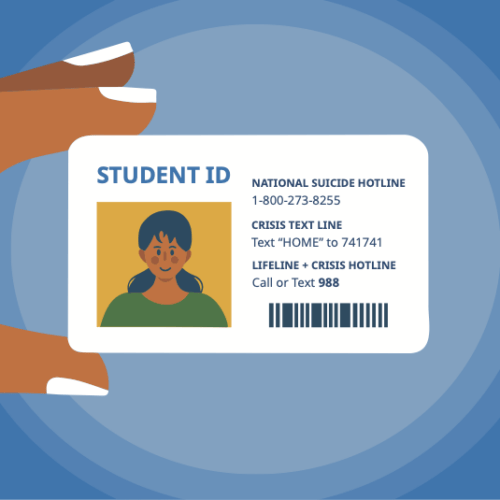
Content Warning: This piece contains mentions of suicide. Getting involved in mental health advocacy in our youth is not easy, but with the emergence of bills like the Student ID Bill (a proposal for schools to print mental health hotline numbers, such as 988, on the back of student ID cards), opportunities for upcoming generations are there. With this in mind, it's important to understand how and why we should advocate for ourselves as youth and be familiar with the mental health legislation being put forth in our country.  As a mental health advocate and former Active Minds Chapter member, I’m excited to share more about my experience advocating for mental health policies and why the Student ID bill is so critical for today’s students: How did you get involved in mental health advocacy? My involvement in activism stems from a personal connection to mental health. My struggles with mental health cast a dark shadow over many of my experiences as a teenager. They were compounded by the cultural shame I faced when seeking treatment as an Asian-Indian woman. The cultural stigma I endured fueled my passion for activism at the age of 14. Embracing vulnerability by sharing my story has allowed me to foster deep connections with the people in my life. We as humans are sentient beings who are unified in our struggles — and by bringing these struggles to the forefront of our existence and conversations, we realize that we’re not alone. Why must youth and young adults be aware of legislation being proposed at local, state, and federal levels? Systemic change in our mental health system is dependent on policy initiatives at the local, state, and federal levels. As young adults, we must be aware of the state of our mental health system because we are the future. Our voices matter, and the decisions made now will impact our futures and the futures of generations to come. What is the Student ID Bill? The Student ID Bill (formally titled the "Increasing Mental Health Access for Students Act") is a proposal that states that schools would print mental health hotline numbers (including 988) on the back of student ID cards. In California, this is already a requirement for all public, private, and charter schools. Why is this bill important in supporting the mental health of youth and young adults? Since its conception in July 2021, the 988 hotline (previously 1-800-273-TALK) has experienced an increase of 48% in the number of calls and 263% in the number of texts. The data is clear: youth and young adults utilize 988, and having this number on the back of an ID card can be life-saving for students or their peers. Having access to a crisis hotline also promotes help-seeking behaviors and can further de-stigmatize the misinformation that surrounds 988 (for example, less than 2% of calls are dispatched to emergency medical services). Suicide is a leading cause of death for young people. Students today are commonly experiencing feelings of loneliness, depression, and anxiety at disproportionate levels. In 2021, 1 in 5 students considered attempting suicide, and 1 in 10 students attempted suicide. More than 40% of students reported that they felt persistent feelings of sadness and hopelessness. However, data has also shown that mental health resources are becoming increasingly utilized. How have you supported the bill, and what success have you seen from those actions? As an activist, this bill is deeply personal to me. I have worked with the Board of Education in my hometown to have them print 988 on the back of Student ID cards in middle and high schools. Furthermore, through my Active Minds Chapter at UCLA, we fought to have crisis hotlines printed on the back of our ID cards in 2019. At the White House Mental Health Youth Action Forum back in 2020, I spoke about the importance of implementing this policy nationwide. How can other young and young adults get involved in advocacy work around the Student ID Bill and other proposed mental health policies? As I’ve learned from pursuing a career in mental health policy, it is essential for all of us to familiarize ourselves with our local representatives and learn about the mental health initiatives in our districts. Starting on a local level, such as in your hometown, is a great way to get your foot in the door into the field of policy work. Your voice always matters; never be afraid to use it.  In our world, where the challenges facing our youth have never been more complex, the Student ID Bill becomes not just a piece of legislation but a symbol of our commitment to nurturing the mental well-being of the next generation. By taking steps to be an advocate, whether at the local or national level, you contribute to the de-stigmatization of mental health across the U.S. Being a part of the conversation on your own campus is just one step to advocacy and can help others understand the legislation at play. Mental health advocacy starts with one voice and can be a catalyst for change.

School Services Article

At Active Minds, we believe policy is key to enacting lasting mental health change – and students play a huge role in facilitating this change. Our new policy platform identifies core policies that we value as an organization and helps us determine what actions to take and legislation to speak out about.  Last month, we unveiled our legislative agenda, which includes four priorities that aid in promoting social equity:  The Improving Mental Health Access for Students Act The Improving Mental Health and Wellness in School Act The Higher Education Mental Health Act The Youth Mental Health and Suicide Prevention Act These priorities aim to advance and support mental health policy as youth and young adults nationwide continue to change the culture around mental health.  As you begin to familiarize yourself with these policies, you may wonder: how can you influence the public conversation and get involved with mental health advocacy? Fatima Anjum and Tyren Boyd, two previous participants in the Active Minds Mental Health Advocacy Academy, share below the importance of student advocacy efforts, as well as simple steps for getting involved today.  One of the key points in understanding the importance of supporting mental health policy and advocacy is recognizing that we all have mental health, and our mental health interacts with various social issues. Historically oppressed communities, including Black, Indigenous, and People of Color (BIPOC) and lesbian, gay, bisexual, transgender, and queer (LGBTQ+) individuals, have their struggles amplified by a lack of mental health support. These groups are less likely and able to seek help for mental health concerns, and when they do, rarely receive appropriate care. Thus, it’s incredibly important to advocate for access to care, as well as access to other necessities that influence our ability to seek care. "Access to healthcare is crucial for maintaining good mental health. Without access to adequate healthcare, individuals may not receive the mental health treatment they need, leading to a decline in their mental health. Affordable housing is also important for mental health because housing [conditions] and homelessness can increase stress and anxiety, while also making it more difficult for individuals to afford healthcare," Fatima shared. Advocating for mental health directs public attention to issues like these, and underscores the need for adequate support.  In addition, using your voice to advocate for mental health helps you serve others, in your community and beyond, in meaningful ways. Tyren’s advocacy campaign, Mental Health Madness, is a wellness fair that allows individuals to learn about different mental health organizations across the state of Mississippi. The campaign is a step toward normalizing seeking help, as well as increasing access to mental health resources and services. From the community level, students can begin to effect change on a state or national level, especially when they choose to learn about and support mental health policy.  “Active Minds has aided me in unpacking what social justice is and how I can go about advocating for social justice issues, whether that be on the local, state, or national level,” Tyren shared.   “They’ve provided me with the space and platform to not only be heard but also the privilege to connect with policy experts.”  If you want to  get involved in policy, learning about different mental health issues and which ones resonate most can be helpful. “You can start by educating yourself about mental health-related issues by reading books and articles, and educating yourself on the policies and laws that impact our well-being,” Fatima shared.  Tyren suggests, “Find your ‘Why?’. Advocating is a passion — you have to have the heart to do the work.”  We will continue to raise awareness of the importance of mental health policy and highlight the unique role that students play in advocating for mental health. By discussing mental health issues through a social justice lens, empowering fellow students, and learning about how policy functions, youth and young adults have the power to transform change.
School Services Article

Our Active Minds Chapter at Morgan State University was definitely created out of necessity. Prior to the creation of the chapter at Morgan State - one of the nation’s historically Black universities (or HBCUs) - there were no student-led organizations dedicated to addressing mental health on campus. Close to the end of her freshman year, our founder and president, Gabrielle Thompson, went through a challenging time, but knew she wasn't the only person who was in need of support. She sought help from the available campus resources, including the MSU Counseling Center and their therapy services. However, upon going through this process herself, she realized how underutilized their services truly were. She wanted more for the students on campus so she decided to create a charter for Active Minds at MSU.  While our story is of course unique to Morgan State, this experience can serve as an example of the increased need for mental health support and resources at HBCUs. The trauma of the COVID-19 pandemic coupled with the spotlight shone toward violence against Black people in the media in recent years has had a tremendous impact on the mental health of the Black community. These factors along with gun violence, climate change, and economic uncertainty have caused young Black people to be more predisposed to depression, anxiety, and stress.  One of the most prominent events that had a major impact on the mental health of our students were the bomb threats sent to HBCUs in early 2022. Between Jan. 4 and Feb. 16, more than 57 bomb threats were sent to HBCUS, places of worship, and other faith-based and academic institutions. Our own school, Morgan State, received a bomb threat on Feb. 1 – the first day of Black History Month. The ironic timing and clear hatred that these unknown suspects expressed toward the Black community sparked a great deal of fear, anger, and anxiety amongst our students. However, despite the chaos that the perpetrators created, our tenacity and resilience as young Black scholars allowed us to overcome that level of hate and continue to prove why HBCUs are so essential to our society in the first place. We want Morgan State’s Active Minds chapter to be a positive influence and refuge not only for its members, but for our entire campus community. Throughout our first full year as an active student organization at MSU, we’ve hosted a variety of events that our students have enjoyed attending and participating in to address their mental health. Some of our events included:  “Dear Future Me”: Students were able to write letters to their future self where they could set goals, reflect, and relax. “Pause for Paws”: In order to alleviate the stress of midterm week, we invited students to join us for an afternoon of play with therapy dogs from an organization called Pets on Wheels. “Mindful Moments”: Our president, Gabrielle Thompson, led participants in an hour of outdoor yoga on The Yard, a communal outdoor space on campus. One of our chapter’s greatest achievements is the presence that we’ve developed on campus. Through the use of social media, collaborations with established student organizations, and developing new and unique events, we have been able to connect with many new students during our inaugural year. With each connection and each event, we are destigmatizing mental health issues while giving our students a much needed outlet to vent and build a community amongst one another.  We believe the best way that our organization can continue to be supported is by having student concerns taken seriously, and by the administration continuing to offer the necessary resources to improve the mental health of students at MSU. The students at Morgan State take pride in our relationship with campus administration in that we are offered platforms to voice our concerns and can actively contribute to the betterment of how students are supported at our school. Faculty, administration, and national organizations like Active Minds can make an immense impact by being present for us through our events, helping to grow our audience by sharing our social media, and spreading the mission of our organization with their communities. As we continue to grow, our goal is to always be there for our students and offer community as we navigate the many trials that come with being college students. Through outreach and service, the Active Minds chapter at Morgan State University will continue to strive for the improvement of our students' mental health and that of our greater Baltimore community. Photo by Morgan State University Student Mikey (Instagram: @mikewilltakeit). 

School Services Article

With increasing urgency over the last few years, educators, school administrators, and even researchers have taken a deeper dive into what equity and inclusion truly looks like within the education system, specifically as it relates to the creation of school policies, initiatives, and programs that take place at the district level and within the walls of the schools. The intention behind the creation of these strategies is to focus on correcting inequities like educational achievement gaps, school-to-prison pipelines, and the exclusion of the cultural histories of Black, Indigenous, and People of Color (BIPOC) and lesbian, gay, bisexual, transgender, and queer (LGBTQ+) youth from the learning experience. These inequities have real impacts, including on the mental health of students at school.  The degradation of student mental health due in part to inequities and lack of resources in our school systems has real consequences. One in six youth between the ages of 6-17 experience a mental health disorder each year and half of students have reported feeling depressed or anxious during the Covid-19 pandemic. Suicide is the third leading cause of death among youth ages 15-19, and for ages 10-14, it is the second leading cause. BIPOC and LGBTQ+ youth also report suicide rates significantly higher than that of their peers. Though school administrations throughout the nation have started to implement action plans to improve the quality of learning for their students, such as changing the hiring policies to ensure that more BIPOC teachers are hired, creating DEI-focused professional development initiatives for teachers, and centering the mental health of students with the creation of social-emotional programs, there is still a long road ahead. Unfortunately, despite these strides, one of the most effective strategies for closing these gaps remains underutilized: the voice of our students. The youth voice is extremely powerful and often overlooked when schools talk about the needs of their students. But guess what? Youth are talking and telling us what they need. And they are asking for: Accurate and accessible information about mental health.  More platforms to talk about mental health amongst each other.  Greater access to supportive adults with knowledge about mental health. When youth are empowered by adults who support and listen to their needs, they flourish. Innovative school-based programs can give students access to the resources that they are requesting.  Active Minds recognizes the power of the student voice and we are taking action to help schools protect our youth and their mental health. We have committed to bringing our proven peer-to-peer mental health model to 1,000 previously unreached K-12 schools in 1,000 days. Schools can get involved by: Helping their students to start an Active Minds chapter, Using our free peer-to-peer high school mental health curriculum, or Bringing one of our engaging and encouraging speakers in to talk to students about mental health education. When youth are brought to the table and asked to contribute, the results end in advocacy and movements that change entire communities for the better.  Mental health issues among youth are rising and we have to respond with solutions that are equitable, effective, and specific to the needs of students. Our schools have to remember that the youth voice is the most powerful resource that we have access to, so let’s use it!

School Services Article
Your Voice is Your Power logo by Active Minds

A collection of mental health resources for youth and young adults who are looking to begin or grow as a mental health leader.

YVYP Resource Hub